

Level A1Fundamentals
Der, Die, Das: German Gender & Articles
Learn suffix patterns (-ung, -heit, -chen, -ling) and semantic rules so you predict noun gender instead of guessing.
Official Web Companion to GermanLogic on Google Play
Stop memorizing random phrasebook lines. German runs on clear rules for der / die / das gender patterns, four grammatical cases, and verb-second word order. Learn the system step by step with Hannah, your tutor inside the GermanLogic Android app.
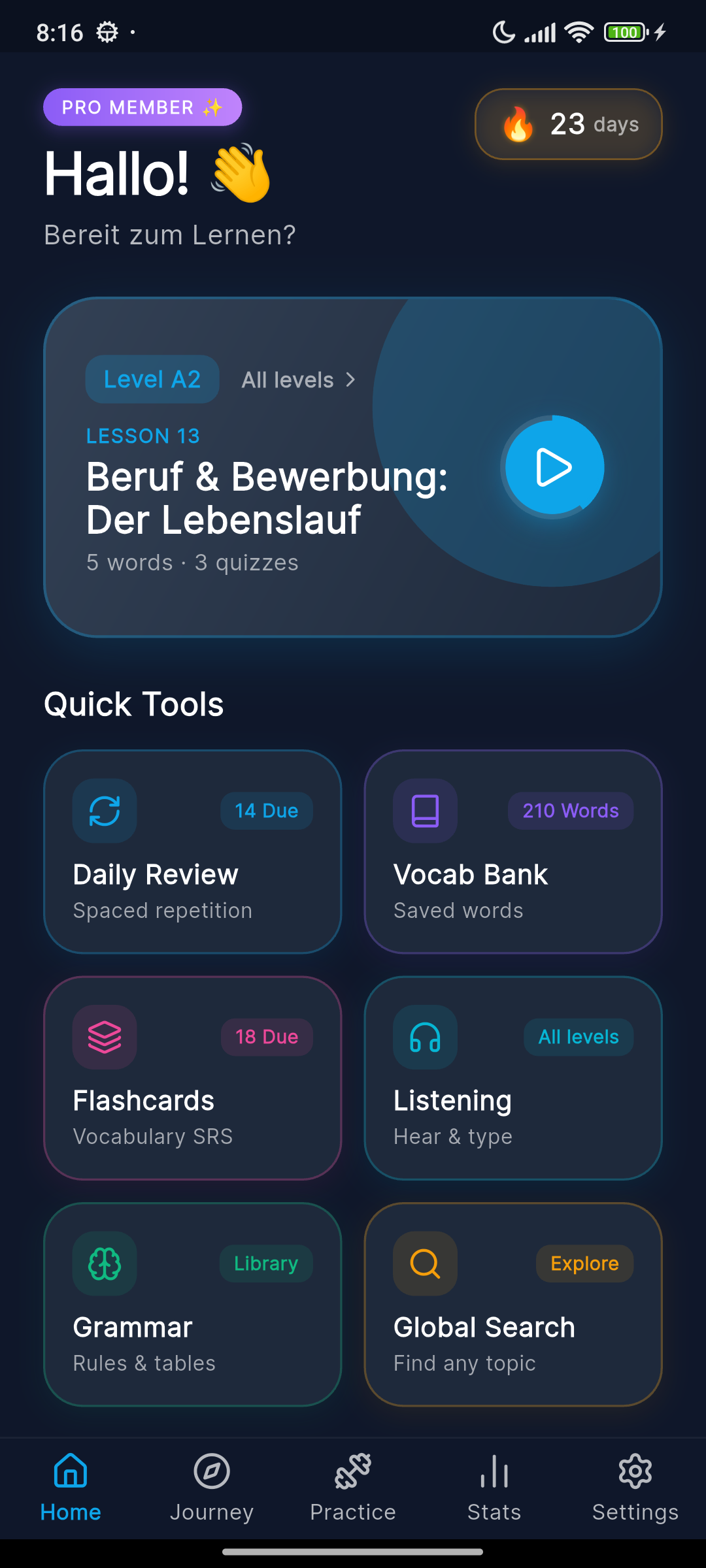
140 A1–C1 Lessons · Daily Review, Flashcards & Grammar Library
apartment·Plural: die Wohnungen
Rule cue: Nouns ending in -ung are reliably feminine (die) across German.
In German main clauses, the conjugated finite verb always sits in Position 2 — even when a time expression moves into Position 1.
01 / Pedagogical Architecture
Once you stop treating German nouns and word order as random exceptions, four clean structural rules explain most of the language.
Suffixes like -ung, -heit, -chen, and -ling plus semantic groups let you predict der / die / das with confidence.
Nominative, Accusative, Dative, and Genitive answer exact role questions and respond predictably to fixed case prepositions.
Main clauses lock the finite verb into Position 2, while separable prefixes and participles close the Satzklammer cleanly.
Our Android app schedules vocabulary flashcards and quiz reviews before you forget them, working offline with no account or ads.
02 / Inside the GermanLogic Android App
Guided by tutor Hannah: 700 core words with colour-coded articles and plurals, 420+ lesson quizzes, 605 practice questions, and device de-DE audio playback.
Alphabet, umlauts, der/die/das basics, present tense, numbers, and everyday survival German.
Accusative & Dative cases, Perfekt past tense, separable & modal verbs, and daily errands.
Subordinate clauses, relative clauses, passive voice, Konjunktiv II, and adjective endings.
Genitive structures, modal particles, subjective modals, workplace register, and nuanced debate.
Nominal style, extended attributes, gerundives, Konjunktiv I, and formal written German.
A1 (30), A2 (30), B1 (30), B2 (30), and C1 (20) step-by-step modules.
Every noun paired with its colour-coded article (der/die/das), plural, and example sentence.
Multiple choice, sentence building, matching, and translation with clear explanations.
Practical English explanations and everyday DACH insights built into every lesson.
Normal + slow German playback using your device voice, plus listening and dictation drills.
Spaced repetition vocabulary & daily reviews — no account required and zero in-app ads.
No account or sign-up required. Progress stays on your phone, and Pro unlocks all 140 lessons, A2–C1 drills, and unlimited SRS reviews.

03 / Complete Grammar Reference (78 Guides)
Every topic from the app’s grammar handbook expanded with comparison tables, colour-coded examples, study tips, and 223 checkpoint quiz questions.
Alphabet & Pronunciation · Noun Gender & Articles · Introduction to the 4 Cases
The Nominative Case · The Accusative Case · The Dative Case
Personal Pronouns · Possessive Pronouns & Articles · Reflexive Pronouns
Predicative vs. Attributive Adjectives · Weak Declension (After der/die/das) · Mixed Declension (After ein/kein/mein)
Present Tense & Stem Changes · Separable & Inseparable Prefix Verbs · Present Perfect (Das Perfekt)
Adverb Order (The TeKaMoLo Rule) · Adverb Types & Comparison · Modal Particles (Abtönungspartikeln)
Prepositions Classified by Case · Two-Way Prepositions & Positional Verbs (Wechselpräpositionen) · Coordinating Conjunctions (ADUSO)
'Es' Constructions (The Many Uses of 'es') · Essential German Idioms & Redewendungen · Functional Phrases for Daily Life
The Extended Attribute (Erweitertes Attribut) · The Gerundive (zu + Partizip I) · Genitive Expressions & Functional Noun Groups
Learn suffix patterns (-ung, -heit, -chen, -ling) and semantic rules so you predict noun gender instead of guessing.
See how articles shift across Nominative, Accusative, Dative, and Genitive side by side with clear roles.
Understand why the conjugated verb locks into Position 2 while participles and prefixes close the Satzklammer.
Master the 5-slot -e vs -en pattern for weak adjective declension across all genders and cases.
Form everyday spoken German past tense accurately with movement/change-of-state rules and ge- placement.
Sound natural in everyday German by using flavor particles to soften requests or show surprise.
04 / Free Linguistic Utilities (12 Tools)
Zero sign-up, instant client-side tools built to demystify German gender rules, verb brackets, adjective endings, compound nouns, and pronunciation.
Look up 595 core nouns or analyze suffixes (-ung, -heit, -chen) with full 4-case article tables.
Conjugate 425 verbs across Präsens, Perfekt, Präteritum, Futur I, Konjunktiv II & Imperativ.
Solve Weak, Mixed, and Strong adjective endings across all 4 cases with step-by-step explanations.
Break long German compounds into modifiers, Fugenelemente (-s-, -n-), and the final Grundwort.
Visualize V2 finite verb placement, Satzklammer brackets, TeKaMoLo adverbs, and Nebensatz clauses.
Convert digits, ordinals (1. erste), Euro prices, and 24h vs colloquial halb drei clock times.
Master A–Z plus Ä, Ö, Ü, ß, Ich-Laut vs Ach-Laut, diphthongs (ei/ie/eu), and IPA cues.
Train tricky contrasts (u/ü, o/ö, ei/ie, ch/sch) and check syllable stress with de-DE audio.
Type ä, ö, ü, ß, € and „…“ on any device with instant ae/oe/ue conversion and copy.
Lightweight iframe widgets (Conjugator, Gender Checker, Numbers) for German teachers & blogs.
30 graded German questions (A1–C1) with an instant score card and personalized study roadmap.
Play Wortspiel (5-letter German word game) and 5 daily Kasus-Builder grammar rounds.
05 / Free German Reference Library
Deterministic conjugation and 4-case declension tables, DACH phrasebooks, spaced-repetition flashcard decks, and printable A4 cheat sheets.
Präsens, Perfekt (haben/sein), Präteritum, Futur I, Konjunktiv II & Imperativ with de-DE audio.
der/die/das gender cues, plurals, N-declension, and all 4 cases across definite & indefinite forms.
Everyday phrases with du vs. Sie register badges, DACH (DE/AT/CH) alternatives, and natural replies.
Practice gender cues, top verbs, separable prefixes, prepositions by case, and DACH phrases in your browser or export directly to Anki.
Clean desk sheets for der/die/das rules, the 4 cases, adjective endings, prepositions, verbs, and V2 word order.
06 / Germany, Austria & Switzerland Life
Dialogue-driven German vocabulary guides with verified official sources for navigating Bürgeramt appointments, housing, health insurance, and daily life.
14-day rule, Wohnungsgeberbestätigung, Bürgeramt dialogue script, and how Anmeldung triggers your Steuer-ID.
Appointment vocabulary, Fiktionsbescheinigung, eAT card terms, and EU Blue Card terminology.
Kaltmiete vs. Warmmiete, Kaution rules, Schufa-Auskunft, Übergabeprotokoll, and landlord phrases.
IBAN, Girocard vs. Debitkarte, VideoIdent terms, and step-by-step branch conversation scripts.
Statutory vs. private insurance vocabulary, eGK card, eAU sick notes, and calling your insurer.
11-digit Steuer-ID vs. Steuernummer, Steuerklassen I–VI explained, ELSTER, and payslip terms.
Regional vs. ICE rules, Gleis changes, Sparpreis tickets, and station announcement vocabulary.
Describing symptoms, prescription types (Rezept), eAU sick leave, and pharmacy dialogues.
07 / Study Smarter
Gender mnemonics, exam overviews, spoken particles, and regional vocabulary across Germany, Austria, and Switzerland.
An honest look at German difficulty for English speakers: why 3 genders and 4 cases look intimidating at first, and how shared cognates and strict rules speed you up.
Stop guessing der, die, or das. Learn the noun endings, semantic groups, and compound word rules that predict German grammatical gender with high accuracy.
Learn the 100 most useful German verbs grouped by pattern—modals, strong, weak, separable, and reflexive—with Perfekt auxiliaries and real sentences.
Neutral guide to Germany, Austria & Switzerland's major German exams: Goethe-Zertifikat, telc Deutsch, TestDaF, DSH & ÖSD—formats, scoring, and uses.
Learn when to use du, ihr, and Sie in Germany, Austria, and Switzerland. Master workplace etiquette, das Du anbieten, verb forms, and regional twists.
Compare German, Austrian, and Swiss standard vocabulary from Tomate/Paradeiser to Fahrrad/Velo, plus ß vs. ss spelling, greetings, and grammar quirks.